
Indian benchmark equity indices experienced a significant downturn, with the Sensex plummeting over 800 points and the Nifty falling sharply, driven by rising crude oil prices, geopolitical tensions, and foreign capital outflows.

Indian benchmark stock indices, Sensex and Nifty, closed nearly 1 per cent lower due to surging crude oil prices, weak global market trends, and significant foreign fund outflows, with geopolitical tensions and inflation concerns further dampening investor sentiment.

Indian markets on Dalal Street rallied sharply as easing tensions in the US-Iran conflict and stable oil prices boosted sentiment. Track Nifty 50 and BSE Sensex performance and key global triggers.

'The West Asia or the Gulf crisis has shown that what we develop as national infrastructure when things are not as bad as they could be, we forget to plan for adversities.'

Foreign Portfolio Investors (FPIs) have withdrawn Rs 14,231 crore from Indian equities so far in May, extending the total outflow for 2026 to over Rs 2 lakh crore, driven by persistent global macroeconomic uncertainties including inflation, interest rates, and geopolitical risks.

'Once the currency goes out of the hand, then possibly your major challenge is that it will not come back.'

'Markets never fully lose hope. But an important shift could come if the Strait remains closed -- moving from high prices to no prices.'

'... with the rest split between mid and smallcaps, as valuations are becoming more attractive across segments.'

JPMorgan has downgraded Indian equities to 'neutral' from 'overweight', citing elevated valuations, rising earnings risks, and limited exposure to next-generation technology like AI. The brokerage believes other emerging markets offer more attractive risk/reward propositions despite India's strong structural growth story.

The Indian rupee rebounded against the US dollar after the Reserve Bank of India (RBI) restricted banks' net open positions in dollars. This move prompted banks to sell dollars, providing temporary support for the rupee amidst ongoing geopolitical tensions and rising oil prices.

US President Donald Trump received a red carpet welcome in Beijing for talks with Chinese President Xi Jinping on trade, the Iran war, and other key issues. The visit underscores the importance both nations place on their relationship amid ongoing tensions.

Reliance Industries' digital arm, Jio Platforms, may see its initial public offering (IPO) delayed to the second half of fiscal 2027, according to CreditSights. The delay is primarily attributed to ongoing geopolitical tensions in the Middle East, which could impact market conditions and investor sentiment.

The Indian real estate sector received a record equity capital inflow of Rs 14.25 billion last year, higher by 25 per cent annually, as developers and institutional investors remained bullish on growth potential, according to CBRE.

India has emerged as the most impacted market within emerging economies, experiencing $3.7 billion in outflows over the past three weeks, matching the total outflows from the entire emerging market basket, as global equity funds turn negative for the first time since January 2026 due to escalating geopolitical tensions.

'It was diminishing even before Trump came to power.' 'The US was at the centre of the global economy. That position is going to become less and less important and less central.'

The Indian Institute of Capital Markets invites applications for its one-year full-time post graduate Securities Markets Programme.

Budget 2026 is an intentional and ambitious one - From manufacturing growth to services supremacy, from technology consumption to AI-powered transformation. This is the blueprint for a $7 trillion economy built on intelligence, not just scale.

Both sides have now revealed a preference for escalation over strategic defeat, and each new provocation narrows the space for the next pause. The Touska seizure, Iran's refusal to negotiate under blockade, Israel's strikes on Iranian oil infrastructure -- all of these add up to an increasingly untenable situation. This makes the wild card -- Trump and his motormouth -- more consequential than ever, notes Prem Panicker in his must read blog on the Iran War.

Alliances fight wars effectively only when they share an endgame. If Israel acted without US knowledge, then the military alliance is operating without real coordination at the level of strategic targeting. Neither picture is reassuring in a war that is no longer regional in its consequences. Prem Panicker continues his must read daily blog on the Gulf War.

India should resist knee-jerk responses to tariff volatility in the US and instead use the current geopolitical churn to build manufacturing scale at home, former G20 Sherpa and former chief executive officer of NITI Aayog Amitabh Kant said on Wednesday.

'Was the five-day pause ever meant to hold, or was it simply another instrument of signaling, of positioning, of buying time in a war where even the pauses are tactical?' asks Prem Panicker in his must read daily blog on the Gulf War.
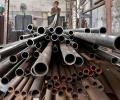
The imposition of safeguard duty, an uptick in exports, and an increase in input cost are driving steel prices higher. The latest round of price increase took place on Friday, with some steel mills increasing hot-rolled coil (HRC) prices by ~500-750 a tonne, according to price reporting and market intelligence firm BigMint. HRC is a benchmark for flat steel.

When everyone has footage and no one can verify it, the loudest voice wins, notes Prem Panicker who begins a daily blog on the War in the Middle East.

4.5 million weddings are expected across India.

Kerala has earned a spot on Rough Guides' list of the world's top travel destinations for 2026, with the popular guidebook publisher highlighting the state as a must-visit location for the year ahead.

After three post-pandemic years of an upcycle, it was a mixed bag for the realty sector in 2025, with sales volumes in the residential real estate moderating across top cities, and commercial real estate and institutional investments emerging as standout performers. Residential: Volumes soften, value holds firm.

'The real story of 2025 is that India officially stopped being a 'market of the future' and started acting as the world's primary economic engine.'

The country's largest IT services company TCS on Thursday announced a tie-up with private equity major TPG for its upcoming data centre business, in which both the partners aim to invest Rs 18,000 crore. TPG will invest $1 billion or around Rs 8,870 crore in the AI data centre business christened as 'Hypervault', and hold a stake between 27.5-49 per cent in the venture.
Equity benchmark indices Sensex and Nifty tumbled in early trade on Monday amid heightened tensions in the Middle East after the US bombed three major nuclear sites in Iran. The 30-share BSE Sensex tumbled 705.65 points to 81,702.52 in early trade. The 50-share NSE Nifty dropped 182.85 points to 24,929.55.

India should simultaneously prioritise domestic exploration and production of more oil and gas in the country, and ensure we retain diversified suppliers for imports, points out former foreign secretary Ranjan Mathai.
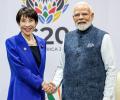
If they act now, they can reshape the strategic map of Asia without firing a shot. If they wait, the next opportunity will come only after a serious Taiwan Strait incident -- by which time the price will be far higher, and the room for boldness far smaller -- the opportunity may well be lost by then. The question is no longer whether this can or should be done, points out Varun Arya.

From the outcome of the general elections and then Union Budget to tepid corporate earnings in the September 2024 quarter (Q2-FY25), sticky inflation and Reserve Bank of India's stance on interest rates, extreme weather conditions, Indian stock markets have braved it all in calendar year 2024.
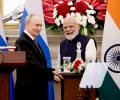
India and Russia have solidified a five-year plan to enhance their economic and trade partnership, while also addressing the ongoing conflict in Ukraine and the threat of terrorism.

The commerce ministry on Tuesday said the discussions with visiting US Chief Negotiator Brendan Lynch on the proposed bilateral trade agreement were positive and forward looking.

Analysts believe Tesla will first focus on building the Model Y brand before expanding -- both in terms of volume and models.

US President Donald Trump's announcement of 25 per cent tariff on all goods coming from India starting August 1, plus an unspecified penalty, is expected to impact Apple's plans to expand iPhone manufacturing in India as well as export of other electronics to the US. The move comes at a time when Indian electronics production is reeling under pressure due to restrictions imposed by China on supply of several critical components, capital goods and even skilled technology professionals.

'The US slump could hit our hosiery market hard since 40 per cent of our exports go there.' 'Job losses could be severe if the government doesn't step in fast.'

India's hospitality sector is rolling out the red carpet for investors. A flurry of upcoming IPOs, or initial public offerings, the entry of new players, and ambitious expansion plans by Indian and global hotel brands are ushering in what could be the industry's most formalised era yet. Leading the charge are real estate titans, who are turning their hotel arms into global hospitality chains.

On the other hand, Bharat Electronics, Kotak Mahindra Bank and Axis Bank were the laggards. In Asian markets, South Korea's Kospi, Japan's Nikkei 225 index, Shanghai's SSE Composite index and Hong Kong's Hang Seng settled higher.

Moody's Ratings on Tuesday cut India's GDP growth projections for 2025 to 6.3 per cent, from 6.5 per cent, saying economies globally will see a slowdown on account of heightened US policy uncertainty and trade restrictions.
 © 2026 Rediff.com - Advertise with us - Disclaimer - Privacy Policy - Sitemap - Feedback - About us - Terms of use - Grievances